
Ask any fleet manager where the real cost sits. Most won't mention sensors, cloud infrastructure, or AI models. They'll mention downtime.
A truck breaks down on the highway between Dallas and Denver. The driver calls dispatch. Dispatch calls maintenance. Maintenance dispatches a tow. Four hours later, the load is four hours late — and the customer already knows. That sequence plays out hundreds of times a day across the US logistics industry. And most of it is preventable.
The global IoT fleet management market was $7 billion in 2023 and is on track for $20.6 billion by 2030, according to Grand View Research. Fleet management accounted for 38% of telematics market share in 2025, according to KeystoneCorp's 2026 Buyer's Guide. That growth is not driven by early adopters chasing new technology. It is driven by operators who got tired of learning about problems after they happened.
This article covers what AI for fleet IoT actually is, which operational problems it addresses, and how the pieces fit together — in language that is useful for the person running the business, not the person writing the code.
A few things this article will and won't do. It will explain the technology through business outcomes. It will use real numbers where they exist. It will tell you where the build-vs-buy question sits — without pretending there is one universal answer.
What it won't do: oversell. Not every fleet needs predictive AI. A 15-vehicle local operation may never recover the investment. A 500-vehicle regional carrier probably will. The difference matters, and we'll get to it.
What Is AI for Fleet IoT — and Why Does It Matter Beyond GPS?
Most fleet operators already have GPS. A device on each vehicle, a map on a screen, a dot that moves. That is a starting point, not a system.
The biggest misconception about fleet IoT is that the hardware is expensive. In 2025, hardware is usually the cheapest part of the stack. Basic GPS hardware often costs roughly $20–80 per vehicle, depending on features and volume. The value — and the cost — is in what you do with the data it generates.
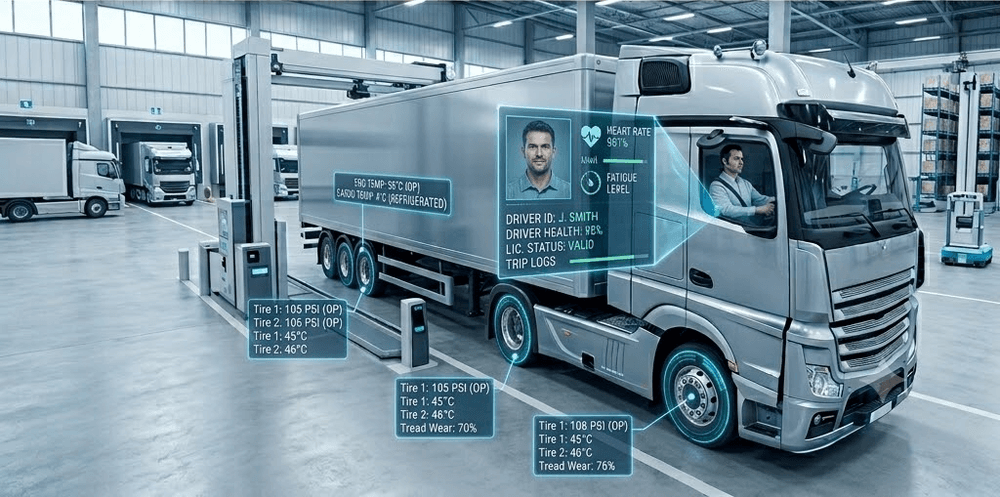
GPS tells you where the truck is. Fleet IoT tells you what is happening inside it: engine temperature, brake wear, cargo humidity, driver behavior, door open events. Add an AI layer, and the system stops describing the present and starts predicting what comes next.
Most logistics companies do not have a visibility problem. They have an action problem. The data exists. Decisions just arrive too late.
In fact, many fleets already collect more data than they know what to do with. The challenge isn't collecting information. It's turning information into decisions before a small issue becomes an expensive one.
A truck leaving Dallas at 6 a.m. generates thousands of sensor readings before it reaches Amarillo. Without a connected system, that data disappears. With one, it feeds a model that has seen the same temperature drift pattern before — usually about 80 miles before a coolant failure. The dispatcher does not get a problem report. They get a maintenance alert. The truck gets rerouted. The load arrives.
That is the operational gap AI for fleet IoT closes. Not a GPS upgrade. A decision infrastructure.
Six Operational Problems Fleet IoT Addresses Today
These are not theoretical use cases. Each one reflects what production systems are doing for mid-market fleets right now.
1. Unexpected Breakdowns
Picture a refrigerated truck that has been running clean diagnostics for six months. On a Wednesday afternoon, tire pressure starts reading slightly low on the rear axle. Nothing alarming. The driver notices nothing. The dispatcher sees a dot on a map.
An IoT system connected to a predictive maintenance model sees something different: the same pressure-drop pattern that preceded three other roadside stops in the past year. It flags the vehicle for inspection at the next stop.
Predictive maintenance is usually sold as a maintenance initiative. Operations teams often become its biggest supporters — because a truck that stays on schedule creates fewer customer issues, fewer dispatch escalations, and more predictable delivery performance. The maintenance savings are real. The scheduling reliability is often worth more.
One documented deployment across a fleet of 350+ vehicles recorded a 40% reduction in operating costs and 1.5x improvement in delivery speed after implementing AI-driven predictive maintenance and route optimization. The biggest driver was eliminating unplanned stops — not fuel, not routing. Downtime.
2. Fuel Costs That Drift
When fuel prices move up 10 cents per gallon, most fleet operators notice it only at the end of the month. By then the damage is done.
Route optimization and idle time monitoring work on both ends of the fuel problem. Dynamic rerouting responds to traffic, weather, and vehicle condition in real time. Idle monitoring identifies drivers who leave engines running at dock stops — a habit that costs more than most operators track.
Live GPS combined with active route optimization delivers 15–20% savings in fleet costs, according to data from the Fleet LatAm Conference (2021). Add fuel behavior analytics and efficiency gains on well-managed deployments can reach 25%.
3. Driver Behavior and Insurance
Driver safety is rarely the reason companies start looking at fleet IoT. Most begin with fuel costs or shipment visibility. The insurance argument becomes obvious only after the system is already in place.
Dashcam AI and telematics data identify hard braking, speeding, fatigue indicators, and distracted driving. The system scores behavior continuously and surfaces patterns for coaching — before an incident, not after.
There is also a cultural component. Drivers are often skeptical of monitoring systems at first. The fleets that see the best results usually position the technology as a coaching tool rather than a surveillance tool. That framing matters more than the software.
Accident-related costs drop by 22% in documented deployments (OxMaint, 2026). The second benefit takes longer to appear: documented driver behavior data is a negotiating tool with insurance carriers. Most operators do not use it that way until a renewal conversation forces the issue.
4. Cargo Condition and Cold Chain
What happens when a refrigerated load spends four minutes above temperature while a dock door is open? Without sensors, the answer is: you find out at delivery, or you don't find out at all.
IoT cargo sensors monitor temperature and humidity inside the trailer continuously. A deviation triggers an immediate alert — to the dispatcher, not the customer. The event gets logged for food safety compliance documentation regardless of outcome.
Spoilage cost reductions of 20% have been reported in cold chain deployments (OxMaint, 2026). For pharmaceutical shippers, the compliance documentation is often worth more than the spoilage savings.
5. Compliance Reporting
Manual data entry in maintenance and compliance workflows produces error rates of 25–40%, according to OxMaint. For ELD logs, DVIR reports, and HOS tracking, those errors are not just inefficiencies — they are regulatory exposure. A single FMCSA non-compliance case costs $7,000 on average in direct fines, with HOS violations reaching $150,000 in documented cases (Embark Safety, 2023).
AI-driven compliance automation handles Electronic Logging Device (ELD) data collection, Driver Vehicle Inspection Reports (DVIR), Hours of Service (HOS) tracking, and FMCSA reporting without manual data entry. Compliance becomes a byproduct of normal operations rather than a separate workstream.
Compliance is rarely the reason companies start evaluating fleet IoT. It usually becomes the easiest argument for keeping it.
6. Disconnected Fleet Data and Dispatch Systems
One fleet operator described the situation plainly: "We had more data than we ever had, but drivers were still calling dispatch to explain what was happening."
That comment comes up surprisingly often. Companies invest in telematics expecting better visibility, then discover that visibility alone doesn't change behavior. The real value appears when data starts triggering actions automatically.
GPS data exists. Sensor data exists. None of it connects automatically to the Transportation Management System. Dispatchers manage exceptions by phone. Updates are manual. Warehouse scheduling responds to arrivals rather than anticipating them.
IoT-TMS integration changes the flow. Location events, idle thresholds, and fault codes trigger automatic status updates in dispatch workflows. Arrivals update warehouse scheduling before the truck pulls in. Dispatchers spend less time chasing updates, warehouses get earlier visibility into arrivals, and customers receive more accurate delivery expectations.
How the System Works — the Four-Layer Version
There is no single piece of software called "fleet IoT." It is a stack. Understanding the four layers helps when evaluating what you already have versus what you need to build or connect.
The hardware layer — GPS gateways, OBD-II devices, dashcams, temperature sensors, door sensors — is the least interesting part, commercially. Most of it is commodity. Teltonika, Queclink, and CalAmp produce standard GPS devices at $20–80 per vehicle with no platform lock-in. The hardware is not the project. The project starts above it.
Data gets from the vehicle to the cloud through a connectivity layer: cellular (LTE or 5G) for most routes, satellite for remote corridors, and low-power wide-area networks (LPWAN) for assets that rarely move. Connectivity choices affect cost and latency — relevant for fleets operating in areas with inconsistent coverage, less relevant for urban operations where LTE is reliable.
The cloud platform is where the intelligence lives. Machine learning models run here, building failure prediction models on historical sensor data, scoring driver behavior patterns, optimizing routes based on live conditions. For decisions where milliseconds matter — collision avoidance, for instance — some processing happens directly on the device. Everything else runs in the cloud.
The application layer is what people actually use: the dispatcher's dashboard, the driver's mobile app, the API that connects to the TMS. A well-designed application layer surfaces the right alert to the right person at the right time. A poorly designed one surfaces everything — and gets ignored. Most of them do.
Many vendors position the AI model as the centerpiece. In practice, bad data collection destroys more fleet IoT projects than weak AI models ever do.
Who Is Already Using This — and What the Numbers Actually Show
Fleet IoT is not a category forming. It is a category consolidating. Samsara (NYSE: IOT) reported $1.5 billion in annual recurring revenue in 2025 at 32% year-over-year growth. That is a public company with institutional investors and audited financials. The market is real.
The adoption curve is compressing by fleet size. Technology that required $500,000 in custom development three years ago now runs $100,000–$150,000 as a well-scoped custom build. Off-the-shelf platforms have brought entry-level capability within reach of 50-vehicle operations.
65% of fleet maintenance teams plan to adopt AI by end of 2026, according to Fleet Rabbit (2026). That is not a prediction about distant future adoption. It is a description of decisions being made right now. The challenges facing logistics operators increasingly come down to technology gaps, not capacity gaps.
The irony is that most fleets already collect enough data. The challenge is that the information often sits in separate systems, spreadsheets, and dashboards without triggering any operational response.
Ready-Made Platform or Custom System — A Brief Framework
Ready-made platforms work well for fleets that need standard GPS tracking, ELD compliance, and driver scoring out of the box. Fast to deploy, subscription-priced, well-supported. If that covers what you need, it is almost certainly the right choice.
A useful rule of thumb: if technology is not part of your competitive advantage, buying is usually the safer decision. If technology is the advantage, building becomes much easier to justify.
Custom development is worth evaluating in three situations. You need fleet data connected directly to a proprietary TMS or WMS that no off-the-shelf platform integrates cleanly. You are building a fleet management product for other companies — a 3PL offering visibility as a service, or a logistics tech company entering the market. Or you need AI capabilities on top of existing IoT infrastructure that no platform provides: anomaly detection, custom predictive maintenance models, dynamic pricing based on route performance data.
The economics have shifted. A production-grade fleet IoT integration with an AI layer, built by an experienced team, can be scoped and prototyped in weeks rather than quarters. That changes the build-vs-buy math considerably.
The detailed breakdown — total cost of ownership, integration complexity, and which scenarios favor each path — is the subject of the next article in this series.
Fleet IoT is no longer a technology question. It is a timing question.
Evaluating a Custom Fleet IoT System?
The engineering problems that show up in fleet IoT — carrier API integrations, real-time data pipelines, mobile interfaces for field teams — are a familiar class of problem. We built GoLocker, a last-mile delivery network in New York City with full integrations across USPS, FedEx, UPS, and DHL. Different product, same underlying challenge: connecting physical assets, real-time events, and external systems into a platform that actually triggers decisions.
For companies evaluating a custom fleet IoT build or an AI layer on top of existing data, we offer a 48-hour AI Prototype — a working proof of concept before any contract is signed. Our delivery methodology, FlowForge, is designed to compress build timelines by up to three times compared to standard development cycles.
If you want to understand what a project scoped to your specific operation would look like and cost, we are happy to have that conversation.