
From concept to field deployment in six months
Defense Technology · United Kingdom
Executive Summary
Rowden is a UK engineering company that designs and builds sensing and information systems for national resilience. Mimic is one of Rowden’s product lines, developed to provide a deployable RF decoy that protects operators from adversary detection and targeting.
This programme focused on delivering the first operational variant in the Mimic range. To accelerate development of the operator-facing software, Rowden partnered with Impressit to provide front-end engineering support.
Working alongside Rowden’s internal team, Impressit contributed to the first deployment within nine months, implementing a robust, intuitive interface aligned with field requirements.
Client Context
Rowden is a UK edge systems engineering company serving defence and national resilience customers. The company designs, builds and delivers sensing and information systems for environments where connectivity is limited, disrupted or denied.
Mimic forms part of Rowden’s sensing and communications portfolio and was developed to address a survivability gap observed in modern conflict operations. In Ukraine and other high-intensity theatres, operators using routine radios and communications equipment were rapidly detected, geolocated, and targeted through adversary RF sensing and electronic warfare systems. Workarounds were inconsistent and often placed additional cognitive and procedural burden on already stretched teams.
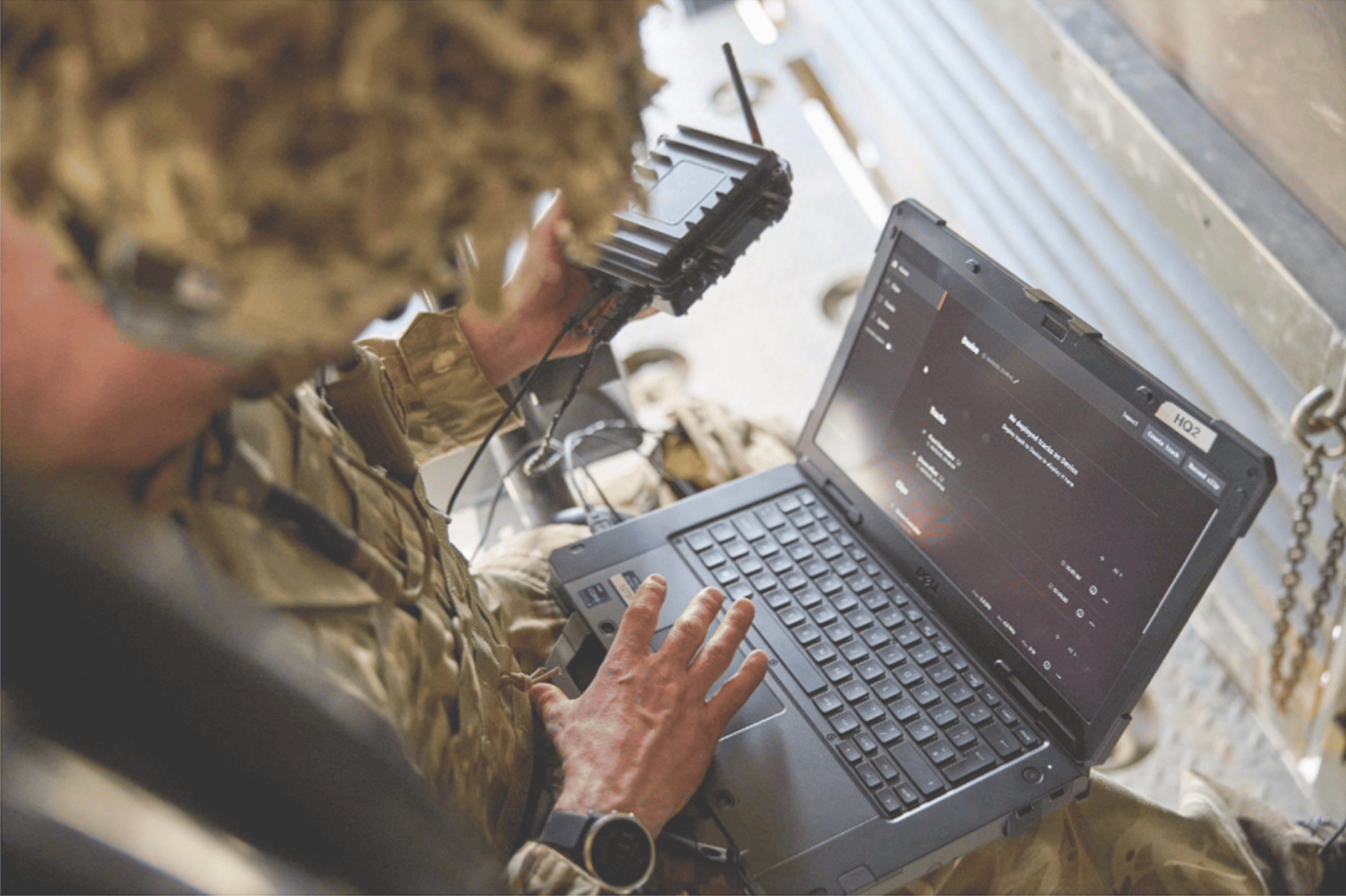
Rowden designed Mimic to address this challenge directly. It is a dedicated electromagnetic decoy capable of emulating battlefield emitters ranging from handheld radios to UAS ground control stations and other tactical communication nodes. By generating credible false signatures, it diverts adversary attention away from real operators and platforms. The programme was funded internally to maintain speed and technical control. The system is engineered to be deployable at scale and usable by generalist operators without specialist electronic warfare training.
As development accelerated, Rowden prioritised internal investment in RF engineering, embedded systems, and networking. To expand delivery capacity without diverting focus from these areas, the company engaged Impressit to support development of the operator-facing web application.
The Challenge
Mimic was initiated with a defined system architecture and early UX flows and wireframes developed in house. The programme followed an accelerated spiral development model, with hardware and software evolving in parallel through short iteration cycles and continuous integration.
The objective was to deliver working units to operators by summer 2025 and ensure the system could be used immediately by generalist operators without specialist training.
Given Ukraine’s relevance as an early operational context, Rowden sought to incorporate additional local perspective into interface development. Impressit’s proximity to the intended environment provided practical insight into how operators interact with systems under real-world conditions.
At the same time, this was Rowden’s first engagement with an external engineering partner for a discrete software workstream. Clear ownership boundaries and integration processes needed to be established quickly to maintain delivery pace and architectural control.
Our Approach
Impressit embedded into the Mimic programme as additional engineering capacity, operating within a unified delivery plan alongside Rowden’s team.
Rowden retained responsibility for system architecture, hardware development, embedded software, firmware, DSP and core backend services. Impressit focused on implementing the associated web application, including the operator-facing interface used to configure devices prior to fielding.
Rowden defined the first UX flows, interaction logic and system constraints. Impressit iterated, and translated designs into a production-ready interface designed to deliver:
- Clear visibility across device states
- Low cognitive load in high-pressure environments
- Reliable performance under constrained connectivity
- Fast interaction cycles suited to tactical use
Development progressed in short cycles, with regular integration into Rowden’s primary codebase. Early interactive builds enabled validation prior to full deployment, and structured operator feedback informed iterative refinements as the system matured.
An early alignment visit in Bristol helped establish shared working practices and a consistent operating rhythm between teams.
Results and Business Value
Rowden delivered the first Mimic units to operators and initial field feedback returned a 10/10 usability score.
Within months of release, Mimic was being exported to six European countries, demonstrating rapid validation beyond its initial operational context.
Key outcomes:
- 10/10 usability score following first deployment
- MVP completed in two months, with full release delivered four months later
- Exported to six European countries within months of launch
- Post-launch software updates delivered on a 2–3 week release cycle
Mimic was engineered as an affordable, attritable system that can be learned in under two hours by generalist operators. Rowden defined the initial UX flows and operational logic to minimise cognitive load, with Impressit developing and implementing the approved interface to production standard.
The collaboration established a structured model for integrating external software capacity into high-tempo defence delivery, providing a foundation for future product scaling.
More of our work
Have a system like this to build?
Tell us the problem — we'll come back with a plan, often within 48 hours.